
Christian Philippsen


CP INTRODUCES THE NOMINEES FOR THE 2025/2026 “PENINSULA CLASSICS BEST OF THE BEST AWARD”
This was the sound of a Ferrari driving through Paris.
Chers Amis, Bonsoir, Good evening!
Glad to be here again, because you are such a wonderful audience!
As most of you know by now, the Peninsula Classics Best of the Best Award – the BoB as we affectionately call it between ourselves – the BoB goes to a car that won Best of Show in one of the leading concours in the world.
But what most of you probably don’t know, because I don’t think I ever explained it, is how we – actually not ‘we’, but the judges – decide on the winner of the BoB. It is a pretty straightforward point system. Each judge names his first, second, and third choices.
-
There are 3 points for the 1st place, 2 for 2nd place and 1 for 3rd place
-
Winner is the car with the highest total
-
The Founding Members and the Steering Committee have no votes and we don’t interfere nor try to influence the judges
-
Looking back, our BoB winners have always not only scored the highest total but also the most first places.
Tonight’s candidates are cars that won concours held in 2025, as they were just listed by Gordon.

Missing, as Bruce Springsteen sang and as Gordon announced, missing is the 1924 Hispano Suiza owned by Lee Anderson from Florida that won Best of Show at the Pebble Beach Concours d’Elegance. Lee Anderson has already had a Duesenberg nominated in the past but, this time, he withdrew due to prior commitments and, I believe, a certain anxiety about taking the car to Europe should it have won, so delicate is that wooden body by Nieuport Astra that took hundreds of hours to restore.
Now, onto our confirmed candidates, in chronological order.

And did he love her!
Clarence Gasque, the financial director of the UK division of Woolworth retailers was married to the heiress of the Woolworth fortune. In an ostentatious display of love and wealth, he gave a Rolls-Royce Phantom I to his wife.

Better known as “The Phantom of Love”, the car was ordered new by Gasque in 1926. He approached coachbuilders Charles Clark & Sons to build the Brougham bodywork, stipulating only that the design was to be French inspired (Gasque was of French ancestry) – and that cost was not a consideration!
Seeking inspiration for this loosely specified commission, the coachbuilder visited the Victoria and Albert Museum in London.
The resulting design was one of the most wonderfully crafted, extravagant, and decadently exotic bodies ever built.


The bill eventually reached an incredible £6,500, when the average UK house price was £500.
Sadly, Clarence Gasque died just 18 months later, and the car was put into storage.
Owned now by Michael Dacre from the UK, it remains entirely original, presenting exactly as it did when new and won Best of Show at the Concours of Elegance at the Royal Hampton Court Palace in England.

Oh! And here is Mrs Gasque…
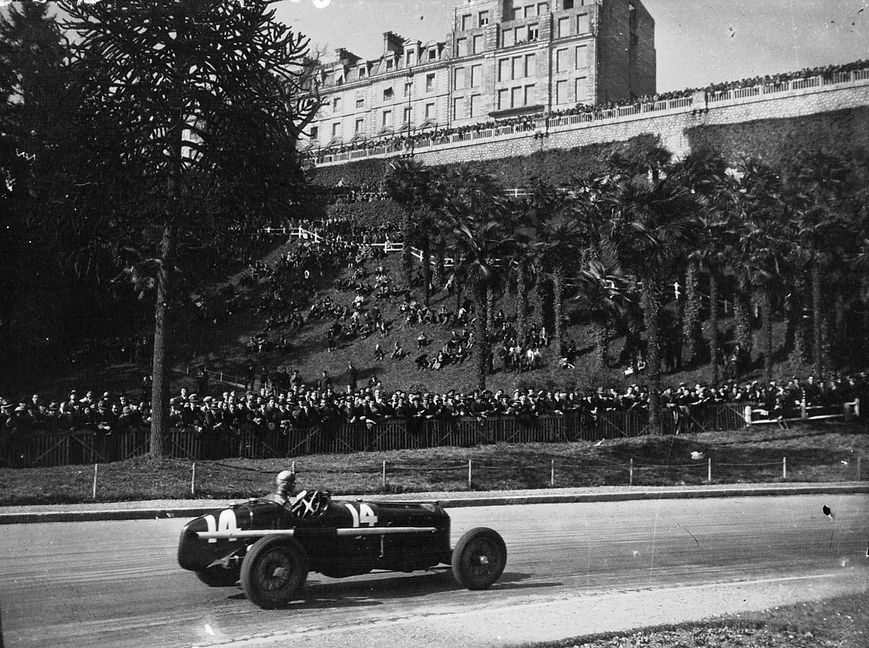
Tazio is arriving, claims the crowd. Tazio refers of course to Tazio Nuvolari, the Italian racing champion of the 1930’s. And it could indeed have been Tazio Nuvolari arriving at the wheel of this 1934 Alfa Romeo Tipo B, but here the crowd was mistaken and it was a sister car to his.
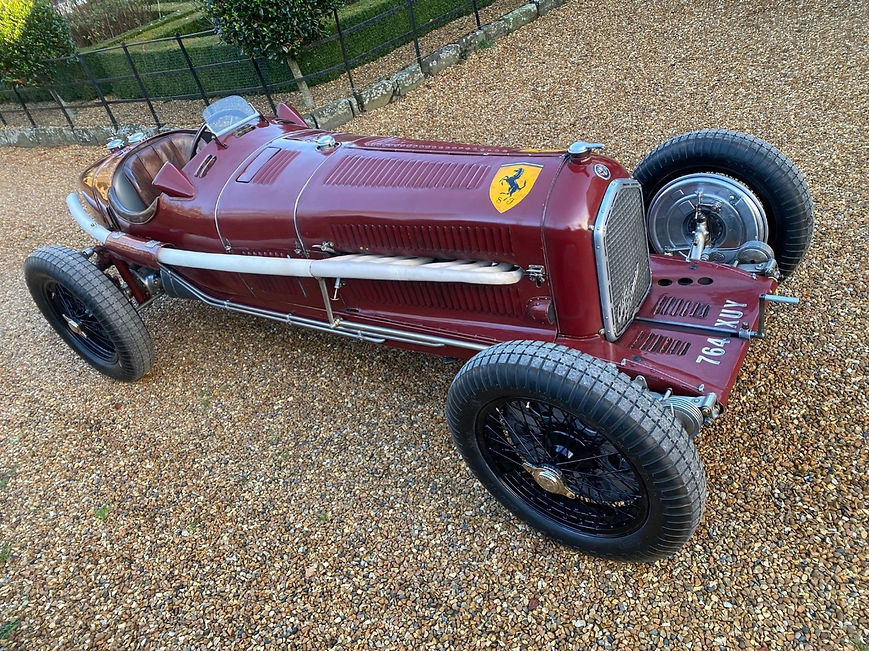
Both cars, prominently displaying the prancing horse emblem, were racing under the same colours of the Scuderia Ferrari which represented the factory, as serious financial difficulties forced Alfa Romeo to “outsource” its racing division.
‘Our’ car was driven by aces such as Antonio Brivio, Louis Chiron or Achille Varzi, and was entered in 35 races in the 1934 season, of which 18 were won.


The Tipo B, also known as P3, was designed by the brilliant Vittorio Jano who had joined Alfa Romeo in 1923, It was the world’s first genuine single-seater Grand Prix car and dominated racing in the early 1930s. The car featured a supercharged 8-cylinder engine with beautiful castings and an innovative drivetrain with a split transmission system and two angled driveshafts, designed to improve traction and balance. Furthermore, the driver sat lower, the seat being positioned between the driveshafts.
Nine were built. This one, now part of the Autiga collection in Germany, won best of show at the Concorso d’Eleganza Villa d’Este in Italy.

Listening to the lyrics of Marleen Dietrich, one can easily imagine her waiting for her lover to pick her up in this Mercedes-Benz. She might not have known that it was a supercharged 500 K Spezial Roadster, but she would certainly have been impressed by its sweeping curves, elongated proportions, and exquisite detailing.

The 500 K introduced in 1934 was developed under the leadership of Hans Nibel, the marque’s head technician. It was available in different body styles, the rarest and most extravagant one being the exclusive Spezial Roadster which epitomizes timeless elegance and the luxury of grand touring. It is regarded as one of the ultimate pre-war grand tourers, competing with the Alfa Romeo 8C 2900 just as both brands were fighting for supremacy on race tracks.

Our nominee was ordered new by exiled Russian Prince Pavel Alexandrovich Chavchavadze at the 1935 Salon de l’Auto in Paris. The car won the Grand Prix d’Honneur at the Cannes Concours d’Elegance the following year, before disappearing into private ownership.


It is now part of the Auriga collection from Germany and won best of show at Salon Privé where it also collected the award for Most Exceptional Coachwork. With their Alfa Romeo Tipo B, Auriga has two nominees this year!

I love the Mariachis, they remind me of all the wonderful moments spent at the Keller collection where they entertained us. And here we have one of the many jewels of that collection, the 1938 Alfa Romeo 8C 2900 spider with coachwork by Stabilimenti Farina. The car is virtually a Tipo B Grand Prix car in road-going form. It was also a direct competitor to the Mercedes-Benz 500 K.

Production of the 8C 2900B was exclusive. While most examples were fitted with bodywork by Touring, that would not do for the first owner of this Alfa Romeo, the famous Italian race-car driver Giuseppe Antonio “Nino” Farina who would become the first official Formula One World Champion in 1950 – 75 years ago.
Nino Farina’s father Giuseppe had founded the Stabilimenti Farina carrozzeria on the day of his son’s birth in 1906; Nino’s uncle, Battista “Pinin” Farina, would launch his own company in 1930.


With such a family background, the hard-driving Nino Farina - a qualified doctor of law nicknamed “the gentleman of Turin” - could scarcely go outside the family to order the bodywork for his new car. As a consequence, it is the only 8C 2900 ever to be fitted with Stabilimenti Farina coachwork. What is more, it was designed for him by Uncle Pinin, despite the fact that Pinin Farina ran a rival company.

Great proportions, with the windscreen right in the middle of the wheelbase.
The car, presented by Deborah Castetter Keller, Arturo’s widow, won Best of show at The Amelia – and it is wonderful, Deborah, that you are keeping the collection alive!

What would bring together Bentley, a well-established British marque, and Facel Metallon, a French company producing aircraft parts?
In 1946, Bentley introduced the Mark VI, the first Bentley completely assembled and finished at their factory, but they continued to supply rolling chassis in limited numbers to specialist coachbuilders.
On the other side of the Pond, in France, Jean Daninos, owner of Facel Metallon quickly realised after World War 2 that the future of his company lay in the development of the automobile.
In 1948, Daninos and Bentley reached an agreement. After a first Bentley coupé called Cresta was produced in small series.

In 1951 he introduced the Cresta II. Designed entirely by Daninos, a man of exquisite taste, it was a more streamlined, sportier, lower coupe. The Cresta II is unique. After building the first car for his wife, there was never another one. The car however announced the upcoming Facel Vega and the end of the ‘entente cordiale’.

“The French, they are a funny race” concluded Marmaduke Thompson, an Englishman who had married a French woman. Marmaduke was the lead character in the novel The Notebooks of Major Thompson authored by no other than Pierre Daninos, Jean’s brother.


The lavishly appointed interior featured cocktail and cosmetic compartments, writing utensils and other gadgets.
Presented by Lukas Hüni from Switzerland on behalf of a private collection, the Cresta II won Best of Show at the Goodwood Festival of Speed Cartier Style & Luxe concours.

“You want to look like an American” wonders Sophia Loren. Had she seen this Ferrari with its duo-tone, finned and chrome-loaded body, and its white-wall tyres?


In June 1954, Robert Wilke of Milwaukee requested Enzo Ferrari to build him a competition coupé for the road. Ferrari offered a 375 MM racing chassis and a 340-horsepower, F1-derived, Lampredi V-12 engine. Wilke then arranged for it to be dressed by Carrozzeria Ghia in Turin. It would be the final Ferrari with coachwork by Ghia who, in those days, did much work for Chrysler.
First proposal sketches were sent, to which Wilke responded with a few ideas of his own. Most were rejected for not “embodying the Ghia personality”.
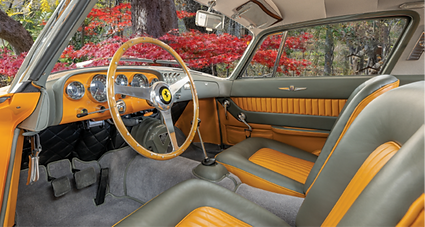

Further sketches were sent, designs were modified, payments were wired, and a unique two-tone body was eventually decided. When completed, the car was displayed on the Ghia stand at the annual Salone dell’Automobile in Torino. It would then return to Maranello for more adjustments before a new transfer to Ghia for one final look-over.
As time passed, a number of increasingly colourful telegrams were exchanged between Milwaukee and Maranello, including a threat of legal action.
The car eventually arrived in New York more than a year after it had been ordered.

Wilke retrieved the Ferrari immediately, and drove it to his home in Milwaukee, enjoying the power and the sound of the engine which had remained typical Ferrari.
The car remained with Wilke until his death in 1970. It is now owned by Tom and Jill Peck from California whose other Ferrari, a 750 Sport Monza, won the BoB a few years back. Their nominated 375 MM is a multiple award winner and was Best of Show at Cavallino Classic in Palm Beach.

“Vincero”, I’ll win, sings Luciano Pavarotti, the tenor from Modena! Winning was the aim of the Ferrari F50 GT, born in 1996 to compete in GT endurance events. Based on the limited production F50 of just 349 units, the project was developed in-house by Ferrari with the assistance of Dallara and a few other subcontractors. Like the road car designed by Pininfarina, it features a monocoque structure made of composite materials.
From an aesthetic point of view, the most notable changes were an air intake on the roof, a different rear wing with central support, and a rear diffuser.


It was equipped with a V12 engine of 4.7 litre with power increased to 750 horsepower at 10,500 rpm. Significantly lighter than the production car at less than 1000 kg, the GT recorded very impressive speeds at Fiorano, the Ferrari test track.
However promising, the project was abandoned after three cars had been assembled, Ferrari deciding at the time to focus its efforts on Formula 1. Ferrari agreed to sell no. 001 to its current owner, Art Zafiropoulo. Of the other two cars, one remains in Maranello and the other went to a private collection in Japan.


This Ferrari is regularly seen at car events and was thought of so greatly that Microsoft scanned the entire car, including sound captured while on a dyno, and created the Forza Motorsport racing games, where the F50 GT was the fastest – virtually!
Though it did not win on a real track, 001 won Best of Show at The Quail, a Motorsports Gathering, after which it received over one million hits on online searches, demonstrating the impact of the great pairing with the wonderful venue that is the Quail Lodge.
*
Voilà, our seven nominees. A great variety … and a difficult choice!
Who’s gonna take the Peninsula Classics Best of the Best trophy home tonight? Who’s gonna take it home tonight? You’ll know soon.
Thank you and, as ever, as per our fellow Founding Member Bruce Meyer’s motto:
“Never lift!”


Partagez cette page / SHARE THIS PAGE